What level of autonomy does Tesla market their latest hardware as? So long as they never label it as being above SAE Level 2 (i.e. don't take your hands of the wheel or eyes off the road ever) then I have no problem with this tech. The only thing they need to fix then is the name of the product. They shouldn't be calling it autopilot as it gives the impression you can answer an email on your phone while the car is doing the commuting for you.
In my opinion Tesla and all other manufacturers should perfect their Level 2 tech (and not call it autopilot) and then jump straight to Level 5, even if it means it's 3 decades out. We can't have drivers sleeping at the wheel in level 3/4 cars with patchy software. And that's regardless of whether manufacturers can prove that their tech has markedly fewer accidents than often-failing human drivers. I'm happy to take the risk to crash with a sleepy fleshdriver, but I'm not ok with crashing due to a software bug. I think many share this sentiment - which means there is a double standard that setting the bar much much higher for autonomous systems than they will ever be for humans.
No, humans cannot operate in the way the product is advertised. It does not work and it invites the human to become complacent and not pay attention. It's a way to weasel and doublespeak your way around shortcomings in the product. A human that doesn't need their hands on the wheel and their eyes on the road 99% of the time will not have their hands on the wheel the 1% of the time that they do.
> All Tesla vehicles produced in our factory, including Model 3, have the hardware needed for full self-driving capability at a safety level substantially greater than that of a human driver.
I should note that both Tesla and you stress hardware capability, not software. Tesla mopes around the bushes with phrases like "awaiting regulatory approval".
If Tesla does actually mean "we've got all the gadgets but the software isn't there yet", they have a serious marketing issue. To the layperson, everything they say makes it sound like their car will make you breakfast, drive you to work and take the kids to school. Seems like they're not there and it's not just regulation holding them up.
At the shallow end, it's misleading advertising, at worst it means people are putting their and their passengers' lives at serious risk.
I would not be surprised if we start seeing mandated health warnings accompany semi-autonomous vehicle adverts, spelling out exactly what they can and cannot do.
I should hope that “all the hardware is there for level5” also means that it operates as a very good level 2 until Tesla enables autonomy - which happens when software and approvals are ready - which may be a decade.
If they sell something now that has hardware for level 5 but neither software nor approval for level 5, but they weasel-maket it as “autopilot” and users can enable a mode where they can let go of the wheel - then they are just criminal.
>I'm happy to take the risk to crash with a sleepy fleshdriver, but I'm not ok with crashing due to a software bug.
I find this very hard to understand, especially when you're making the choice on behalf of others. Would you drive your children to school, knowing that you're making them less safe, just so that if they do die it's your fault rather than that of some programmer?
I'm not entirely sure why I accept being hit by a drunk driver but not by an AI driver. I suspect that first of all, my reasoning can not be backed up by pure reasoning and numbers, so any attempt to say that "look, our AI is safer than humans we should allow it" is probably doomed to fail (I mean I'm a bloody programmer by trade and even I refuse to accept simple statistical arguments in this case! - what will then "regular" people think?)
But perhaps the most convincing argument is that even the drunk, sleepy or sloppy driver at least takes a reciprocal risk in traffic. The one thing that makes me believe that people try their best to avoid hitting me is that we will both be in the accident.
Simply put: we are sort of fine with being put at risk by human behavior. That's part of of the risks we have already accepted. This is a new risk and even if it reduces another risk (fewer human drivers) we classify it as a "new risk" and we are risk averse.
It seems to me that people are actually more likely to take unreasonable risks when they have to make these calls on the spot. We often overestimate our ability to handle difficult situations and are prone to valuing "getting there in time" more than playing it safe.
NASA is known to define a set of strict and absolute mission rules before the beginning of a mission for just this reason. See for example the rules defined for various Apollo missions [1]. Note how those rules define all sorts of limits and abort triggering conditions. This is done because there is always a desire accomplish the mission even when something has gone wrong.
Sure, which might mean that the programmer is more careless and might cause more crashes.
But if you've already stipulated that the driverless cars are safe than driven ones, then that fact is irrelevant. The program has already been written and if it is in fact safer than my own driving then I would want to use it.
That's the scary and also dangerous part: the behavior might be ok at some point, and might fail at another point. Tesla's (and NTSB) investigations will likely find out what went wrong in this particular accident and on this part of the road, and likely will improve the systems. But users are certainly not enough aware of that kind of risk: they might try the Autopilot, see that it works, and trust that if it worked, it will work again and again and again... On a daily commute for example, if it worked many days in a row, and then fails for some reason (technical, external, whatever), the user will likely fail to notice.
> On a daily commute for example, if it worked many days in a row, and then fails for some reason (technical, external, whatever), the user will likely fail to notice
Yup. This is why I won't get into a self-driving car until they're fully driverless.
Drivers become less attentive as the system gets better.
That is waaay too close for no one to be screaming in the car!
I don't understand how the Tesla couldn't see the centre barrier but it can detect when a crash is about it happen, can someone explain that?
It can't detect when a crash is about to happen. The driver manually pushes the brakes there.
I have only worked tangentially with self-driving systems but in general they are very bad at dealing with stationary objects - this is why it can't see the center barrier.
The latest Waymo video [1] says its car can see up to 3 football fields away. I would guess this would let it operate at higher speeds. I haven't seen any demos of it on the highway. I think they're focused on cities and suburbs.
> I don't understand how the Tesla couldn't see the centre barrier but it can detect when a crash is about it happen, can someone explain that?
AFAIK the AP focuses more on moving targets for collision avoidance, stationary objects are harder because there's so many of them you'll never hit since they're above or next to the road, but that's hard to tell until they're very close (can't see where the road leads to 100m away).
I get that the system is designed to follow the white line, and that in this nightmarish freeway design, the white line leads straight into the divider. But I thought that the whole point of LIDAR/whatever Tesla uses for object detection was to be able to detect upcoming objects. This seems to have been a problem in the Uber pedestrian crash as well - while it was clear from that video that a human driver probably couldn’t have seen the woman, a LIDAR equipped vehicle should have easily detected that she was there and avoided her (and that Uber vehicle had full LIDAR I believe).
So what is going on here? I’m not a radar expert. Is there some fundamental flaw with this technology that is preventing it from “seeing” all objects under all circumstances? Or does the problem arise from faulty driving logic...perhaps the object detection system reports the object, and for whatever reason the system interpreting that data ignores it?
Tesla cars don’t have LIDAR, Google’s waymo does. You’ll generally be able to tell if the car has lidar because you can’t quite miss it, it’ll be that big dome-like object on the car.
Right, which is why I used the “/whatever Tesla uses” in my comment (I should have just said object detection technology instead of LIDAR). I believe Tesla is using a combination radar and cameras and they believe this is as good as LIDAR. Redgardles, I believe that Uber actually uses full LIDAR and that crash still happened.
So the question still stands. Are all of these object detection technologies fatally flawed, or is it the software that is interpreting this data that is to blame?
Any car with distance sensing cruise control or collision avoidance at least has some kind of forward looking radar tech, right? So it should at least be able to panic-break when noticing the mistake? It looked like the car had gone full speed into the barrier.
But this seems like the hardest thing for radar to see. Moving cars are easy to distinguish from the ground because they have a different doppler shift, but a stationary object does not.
No, Tesla mentioned in a blog posts that the system gets confused by many static objects like the things above the road, so they have some code to ignore them. They detect the objects but have issues identifying them
https://www.tesla.com/blog/upgrading-autopilot-seeing-world-...
By no you mean yes? The point is that sudden braking of the car in front is easy to detect on radar, but distinguishing static objects which you must avoid from the many which you need not (signs, trees, cat's eyes, gravel) is very difficult.
Sorry if I was confusing, Tesla hardware seems to detect the static objects(like cans on the road) but they put software to filter some objects out, I hope we will get some logs of the crash (can people pull the logs from their Teslas or are DRMed?) If we had the logs we would know if the car ignored the object or the hardware it is just blind for some objects.
Loss of even 1 life is far greater than the convenience gain for all other passengers combined. Current autopilot technology just isn't ready for the roads yet (some of them like this one in the video constructed with gross incompetence). This and many such future accidents to follow cannot be fixed by simple software glitches, instead, auto driving car manufacturers should be required to construct magnetic road white stripes for major highways and routes.
It's not just convenience. Human drivers make mistakes and die all the time. If every car in the US had autopilot and half the rate of fatal crashes (not perfect!), you'd save 18,000 lives each year.
If the fatal crashes are prevented with automatic emergency breaking, why drag in rest of autopilot? AEB is a simple assistance technology that's standard on most new vehicles
> Current autopilot technology just isn't ready for the roads yet (some of them like this one in the video constructed with gross incompetence)
I disagree. AP is ready for very common situations and acts faster/better than a human driver there (e.g. rear-end collisions). It's not as capable of judging some extreme situations as a good human driver yet. We'll have to fix roads in some situations, but we'll also all benefit from having at least collision avoidance assistance in the cars.
That is not AP, is lane assist and collision detection, other cars also have this tech, the problem with Tesla is that they market it as AP, the driver should always keep his hand on the wheel and eyes on the road with this systems.
AP will not be ready for many years, and it will get a bad reputation because of companies like Tesla or Uber that push things that are not ready.
Are you sure? Your argument reduces to absurdity, because if a single life is never an acceptable trade-off for convenience, we should set a global speed limit of 5mph.
1) Given Tesla has been using passive data collection wouldn't a well traveled road like this have clear data that there is a split road but nothing in the middle so geo-position should have stopped this?
2) How did the radar /camera not see the barrier.
3) Give their update capability I'm surprised this section of road hasn't been fixed or updated to stop 'autopilot' for this section.
Automated mapping seems like it ought to be able to solve this. Even if the cameras are less good than a human, all the other cars' cameras could help immensely.
Why isn't every Tesla tracking all the lanes it can see, and the behaviour of every option at every exit, and flagging cases where one of the other lanes does something weird, or dangerous, half a mile later?
Are they even collecting that kind of data, let alone using it to make decisions in autopilot mode? I know they're using passively collected data to decide whether radar detections of passive objects are actual threats or just road signs, but I'm not sure they've announced anything more advanced than that.
10,000 human drivers a day handle it just fine. Again the night-time video is poor and a human can pick up so many other subtle clues. I'd bet all the non auto-pilot accidents at this spot are from drivers cutting across at the last second.
But it appears the combination of lines and narrow barrier and the curve don't get properly detected by the car's algorithm. It's an edge case, but with the state of roads in the US and the lack of maintenance, I don't see how an algorithm can handle every possible case. I know lane markings are worn and faded all over my town.
Except when not - apparently this divider is frequently crashed into, by humans. Perhaps that is the underlying issue; combined with the softwarish happy-path mindset ("let's assume the road is adequately maintained, because that's somebody else's problem"), this gets lethal.
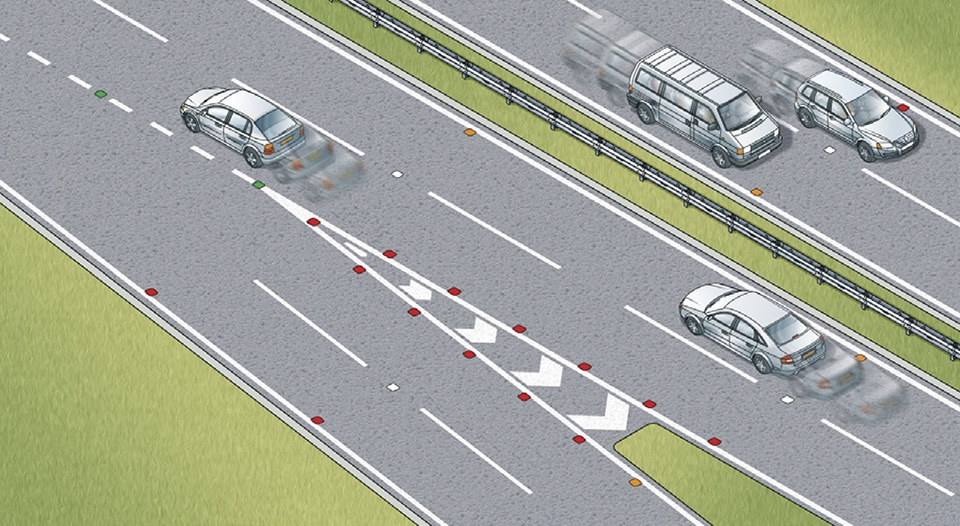
What should the road look like (without the low dynamic range of the camera)? It looks like that's a junction and there should be a hashed white area between the slip road and the highway. At least that's what you'd see in the UK.
In Britain you can contest parking fines if the double yellow lines are patchy, because arguably you could have missed them. There's also (I think) some laws that say that in order to enforce fines regions must be correctly marked, so the council has a duty to keep them well-painted. Seems like Tesla would argue similarly here.
Indeed, that's what's supposed to be there. Alas, "do not worry about things that shouldn't exist but do, or about things that don't exist but should" is not a viable strategy on the road.
Parking fines are different as you cannot know about the restriction if there's no line. When driving, it's your responsibility to stay safe. If road markings and/or are bad, you have to slow down to avoid any danger.
The government has some limited duty to keep roads intact but you cannot expect perfect road conditions at all times. It would've been different if there had been an object on the road that the police knew about but chose not to remove.
When driving on roads with poor markings, I always follow other cars in front of me and in the other lanes to determine where my lane is. It's better to be in sync with the rest of the traffic than being "correct".
I'm a bit confused that self driving cars (at least Teslas) appear to ignore that. Even if they were right and it was the correct lane, isn't following it more dangerous than staying in sync with traffic?
The autopilot likely thought the other cars took an off-ramp and staid on the highway by following the left lane.
I'm surprised there aren't a marked (hatched) area at the junction though. But regardless, the car has to be able to handle even mis-marked or temporary roadwork.
That's a good way to get off the road - e.g. at night, in the snow. Seen that more than once - the previous car might be going straight because they lost traction in a curve. Do not overestimate the wisdom of the crowds, especially in a crowd of one.
Fair point; not sure how much the current code is ready for incorporating the collective intent. Another issue: what if the other 10 cars are also self-driving into a wall? With such a low quorum, you are still vulnerable to the same issue as with a single car.
I think the problem is that, as things stand[1], autonomous cars are an "AI hard" problem, in that you'd need to build something of equivalent general intelligence to a human.
[1] One example of how things might change is if societies decided to build "smart roads" to assist AI drivers, and then banned non AI drivers from them.
A smart road could be like a train track, completely automated, then you would enter in a cart, input a destination and the centralized system will compute yo2ur route and speeds, this needs a lot more infrastructure but theoretically you could have huge speeds and no stops at intersections, just some small slowdowns to allow carts pass near each other at intersections.
> Our data shows that Tesla owners have driven this same stretch of highway with Autopilot engaged roughly 85,000 times since Autopilot was first rolled out in 2015 and roughly 20,000 times since just the beginning of the year, and there has never been an accident that we know of. There are over 200 successful Autopilot trips per day on this exact stretch of road.
Do we know how many of those trips were made with the same software version as the victim's? And do we know how many of those trips were in that particular lane?
Not just a Tesla problem as I recon all cars using lane markings will have done the same. My Passat will constantly try to pull me into off-ramps or whenever theres old paint or other weird markings.
But the difference is that other car manufacturers deliberately don't label it Autopilot. They call it "lane assist" (or similar). That makes clear that it keeps you in the lane, not that it drives the car for you. I.e., without proper lanes it cannot work.
I don't think Tesla's capabilities are the issue, their marketing is. They should've never called it Autopilot if it's just the standard adaptive cruise control + lane assist that nearly all manufacturers offer.
Other manufacturers market that product for collision avoidance, not to drive the car for you. These features can help to avoid accidents when the driver is tired or doesn't pay attention.
And then some SV startups decided to abuse people trust and named a lane assist feature as autopilot, put tons of marketing into showing how great the autopilot is and very soon we will no need to have a human driver.
At least is not named autopilot and hyped to extreme, if you check the Tesla reddit you will see that the problem is excused and the driver is using the car wrong.
Correct me if I am wrong, but the car followed the bolder line instead of a barely visible one? Could it be sunlight + concrete + bad vision of the lane line?
I've read the concept that a self driving car cannot react to everything that it sees in front of it because otherwise it would basically be inoperable, ie, it has to disregard things like overhead signs, bridges crossing over the highway etc, because braking for those is unnecessary and possibly dangerous.
But, when the car detects these things and decides to disregard them, does it just forget about them? Just thinking back to the Tesla car that ended up going under the truck crossing in its path, supposedly the car didn't react as you would expect because it assumed it was an overhead sign. But I would think that an overhead sign would begin to look different than a truck on the road crossing in front of you as you continue to get closer to it, is the software not capable of at first deciding to disregard something up ahead but then change its mind as it gets closer? Likewise with a concrete stanchion that keeps getting closer and closer? Does the software allow for it to second guess itself?
This seems very hard for Tesla to fix with a simple software patch. If the car is using cameras to look at the lines on the road + radar which can not see stationary objects well, then I don't see how they'd have enough sensor information to fix this reliably.
In principle the cameras can see the stationary object like we can, after all, we don't have LIDAR.
Fundamentally, though, that does seem like the long route to self driving. Being able to not drive into the proverbial wall seems like Job #1 of a pilot system. Tesla need to be careful they're not not creating a reputation for themselves at this point.
They have many cars passing those places, can't they improve the maps they have, in the places where the video inputs and Tesla maps will conflict decide to slow down and ask the human to take over, then analyze the issue and add is as a unit test.
Improving maps only papers over the issue at this one particular place. What happens when this happens somewhere else, where there's no marking in the map instructing the lane-keeping software "this is a known bug, follow the right lane marker here"?
I don't mean of marking this spot, but soemthing like
1 this is a new road, "autopilot" will not engage but collect data and add it to the map
2 after 100 or other better number of cars passed that point and the maps are updated enough AP can engage
3 if radar+camera detects something that does not match the maps it slows down and asks the human to take over, the maps are used as a way to double check what the AI wants to do.
This system will not work on small roads with few Tesla cars on them but it will prevent problems on big roads and collect useful data to add to the unit tests
In other words, better roads get better, worse roads get nothing. Isn't that reinforcing the current problem of "SDVs drive well in areas where SDVs drive well; beyond the map edge there be dragons"? See my reply earlier: https://news.ycombinator.com/item?id=16706856
Is not this better then no road gets safer? At least high traffic roads get safer, less damages and live lost, fixing the bugs that are discovered here could improve the situation on smaller roads.
My idea was how they could act on this situations with the drive assist tech(stupidly named autopilot) I am not of the opinion that true self driving cars are around the corner, not even in major US cities.
They would fail too, but I'm not aware of any adaptive cruise control from any manufacturer being sold as "autopilot".
In either case, I think the biggest(and insurmountable) obstacle to self-driving cars will be the fact that they rely on having clear signs, clear markings, clear lanes, signs not rotated by the wind or vandalised - and it's going to be impossible(due to cost) to maintain our infrastructure to the required level. Yes, Tesla can patch their system to work in this specific road situation - but there will be countless others.
But what happens when you have tons of self driving cars, and it starts snowing, do all this cars get stuck until the snowing stops and how can you clear the roads if the cars are stuck? (I am referring at a scenario where this are actual self driving cars and not drive assist systems with a human behind the wheel)
Isn't lane keeping designed to avoid that you accidentally leave the lane? I'm not aware of any OEMs except Tesla marketing it as doing the job for you (except for congestion at low speed).
VW writes:
> The Lane Assist system is like a friendly co-driver. If it senses your car is drifting out of your driving lane it gently counter-steers the car back on line.
They explicitly say that it only corrects you, it doesn't replace steering by the driver.
I wonder if autopilot networks will eventually reroute vehicles around bug-prone locations like this. The only problem is recognizing bug-prone locations. It is interesting to think of some geographic locations as wells of danger that are best avoided...
UK driver here. If self driving cars rely on lane markings for working out where to sit on a road, how does it work on country lanes or newly laid roads?


In my opinion Tesla and all other manufacturers should perfect their Level 2 tech (and not call it autopilot) and then jump straight to Level 5, even if it means it's 3 decades out. We can't have drivers sleeping at the wheel in level 3/4 cars with patchy software. And that's regardless of whether manufacturers can prove that their tech has markedly fewer accidents than often-failing human drivers. I'm happy to take the risk to crash with a sleepy fleshdriver, but I'm not ok with crashing due to a software bug. I think many share this sentiment - which means there is a double standard that setting the bar much much higher for autonomous systems than they will ever be for humans.