I appreciate the comparison but it's really not "much the same". Modern F1 cars are much much better (not just faster) than they were in 1972.
The strict technical regulations are in place for two main reasons:
1. To allow teams with smaller budgets to compete.
2. To focus innovation away from simply making bigger, more powerful engines with computers managing every facet of driver input and car output. That kind of technology will (and currently is) making it's way into roadcars anyway, it doesn't need the help of F1. F1 enforces constraints in the usual suspects (engines, driver assists, ECU, tyres, etc.) which pushes engineers to come up with genuinely new and creative approaches to making cars better and faster. This is all done within the competitive arena of sport. It's actually quite a smart way to bring about a particular type of innovation (I'm trying not to say "out-of-the-box thinking") that may not necessarily happen naturally but may still eventually make it's way into roadcars.
away from simply making bigger, more powerful engines with computers managing every facet of driver input and car output
While there has been some of this back in the 80s (e.g., the Williams FW14B[1]), these regulations are also blocking a whole lot of real out-of-the-box thinking.
When I think of technical innovations from F1, I think of cars that showcased really unusual technologies. Some of my favorites have been the 1976 Tyrrell six-wheel car [2], which used four small wheels in the front to improve downforce; and the 1978 Brabham BT46 "fan car" [3], which used a big fan like a vacuum, sucking the car down onto the track for better traction.
These regulations may help prevent escalation of dumb "big iron", but they also completely shut the door on any kind of revolutionary thinking.
> 1. To allow teams with smaller budgets to compete.
There's a far better way to help the smaller teams: Split the sport's revenues more equally.
Under the current regime, the top teams receive many times the amount the smallest teams do (e.g. more than a 9x difference between what the Constructors' Champion receives and the paltry $10m the bottom two teams are given) - http://www.hindustantimes.com/Images/Popup/2012/10/24-10-12-...
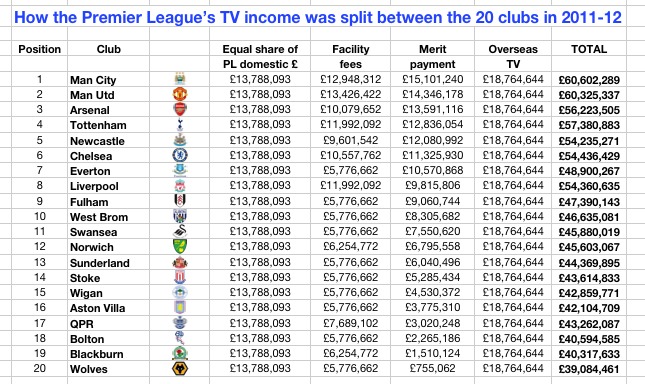
But if you look at total income, the difference still is huge. The top has way more income from merchandise, sponsorship, and revenue share from UEFA tournaments (champions league, in particular)
I'm not familiar with the sport at all, but Red Bull's other sponsorship ventures would lead me to think that the money they would spend on a team is not tied to the direct profitability of it. It would help letting smaller teams have a bit more cash, but it wouldn't prevent the top teams from continuing to spend them out of competition. We actually have seen this as well in the Premier League. To really get balanced competition you need a host of financial regulations, not just caps and limited revenue sharing, with a monopoly on your sports leauge, ala the NFL.
Not sure the premiership is a good model it sucks all of the money away from the lower divisions.
The premiership also has been trying to wall its self off from the other clubs so that they dont have relegation - unlike the NFL the worst performing teams get relegated which keeps the teams honest to an extent.
The one thing I think all US sports should incorporate is the idea of relegation. It make the rest of the season so much more exciting.
It's like one of the commentators pointed out. The Premiership is one of those leagues that even if you're mid-table, you might be safe since there are more points between say the #1 team and the #5 team as opposed to the number of points which separate the #5 team and the #20 team.
Plus, now it's just as exciting who's going down and who's staying up. As well as which teams from the Championship is getting their big break and can they stay up for more than one year?
If US teams had more of a setup like this, the story lines would be endless. I think it makes for a much more fan friendly league.


The strict technical regulations are in place for two main reasons:
1. To allow teams with smaller budgets to compete.
2. To focus innovation away from simply making bigger, more powerful engines with computers managing every facet of driver input and car output. That kind of technology will (and currently is) making it's way into roadcars anyway, it doesn't need the help of F1. F1 enforces constraints in the usual suspects (engines, driver assists, ECU, tyres, etc.) which pushes engineers to come up with genuinely new and creative approaches to making cars better and faster. This is all done within the competitive arena of sport. It's actually quite a smart way to bring about a particular type of innovation (I'm trying not to say "out-of-the-box thinking") that may not necessarily happen naturally but may still eventually make it's way into roadcars.