I have been waiting for this for 50 years! It is wonderful that Roger Penrose and my father, Alan Mackay, are still alive to see it! If only Escher could see it!
Neat! I'm impressed at its simplicity, after the complexity of the disconnected aperiodic Socolar-Taylor "tile" [1]. I am a bit disappointed it needs reflections though (the tiles are all the same shape but only fit together if you flip some of them over).
Weird (to me) that five out of six images show the 3D case, which is way harder to understand than a tile on a 2D plane, at least in my view.
It's also weird, for someone not at all familiar with the problem, that the concept of a "tile" includes non-connected shapes, i.e. there are outliers that are considered part of the tile but not connected to the main body. Apologies for absolutely no clue about terminology here.
> It's also weird, for someone not at all familiar with the problem, that the concept of a "tile" includes non-connected shapes
The base concept here isn't the idea of a "tile". It's the idea of "tiling the plane", where "tile" is a verb. You tile the plane with a shape by repeating the shape over it and covering the whole space without leaving any holes or causing any overlaps.
Once you've defined the problem as "tiling", it's a natural step to call whatever shapes you happen to be using in your tiling scheme "tiles".
I think the non-connected 'tile' was interesting simply because they hadn't yet found a connected one. When stuck solving a problem it's often helpful to look at what solutions would look like if some of the constraints were relaxed.
But in fact, the connected solution ended up much simpler than the disconnected one!
Find you a local pottery. Tiles are totally something you can still do in smallish quantity by hand. Mind that they won't be "calibrated" tiles though so it'll be a bit trickier to lay them neatly.
EDIT: Be sure to get mirror copies made too. It'd be a shame to go through all the effort and end up with the backside of tiles showing.
I guess the strongest possible result would be a tile that can cover the plane aperiodically without reflections, but which can't cover the plane periodically even with reflections.
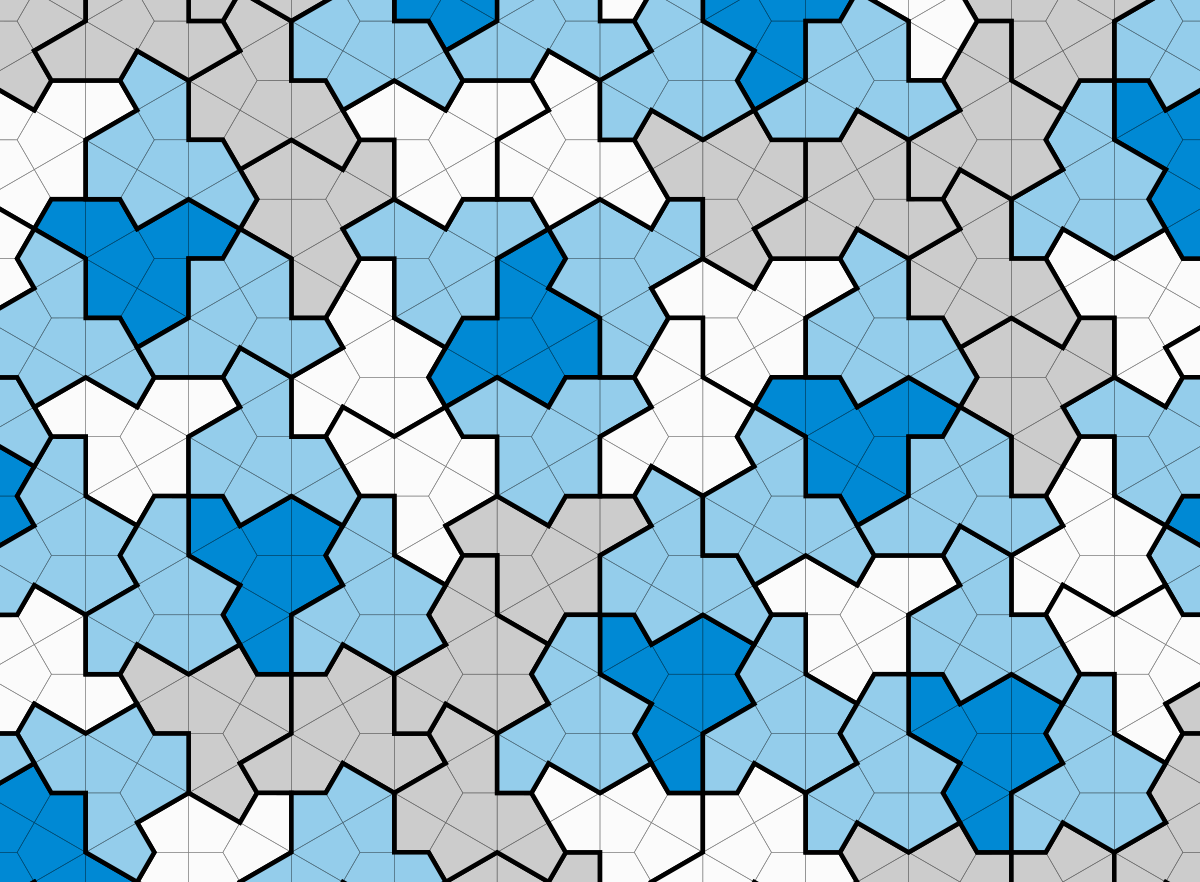
Correct, the colors are not part of the tiling. They showi some additional structure which is used in the proofs of aperiodicity (and tiling). That said, the coloring is chosen in relation to the dark blue tiles, which are reflected relative to all other tiles.
I think they show the clusters? Light/dark blue = H, gray = F, white = T or P. Not sure, seems like you’d want one color per cluster rather than two colors for one and one color for two.
Yes, it's good pun. That is what's amusing. No-one is taking it for a random coincidence.
"they call the Monotile an "einstein" because that is German for "one stone"" - does this sentence not say that this is "exactly why they named it that"?
Clarity in writing is good in most cases, but necessarily not always so in humour: Strategic ambiguity implying both meanings is a frequent element of humour.
You seemed genuinely interested in why you were not understood, so I was explaining my perspective. You can either get better at communicating or not, at your discretion.
And if you use them in your house, future archeologists could definitely date your ruins to no earlier than 2022/2023. If you had a document and wanted to prevent it from being “backdated” earlier than 2022/2023, you could use the tiling pattern as a background. A geometric time stamp of sorts.
Either that, or it would upend the future understanding of our progress in geometry if you print it with old ink on old stock paper that’s dated substantially earlier than 2022/23.
Very interesting idea! We just have to be sure that these tiles don't already exists in some crystals or materials, in biological creatures, or somewhere else.
Procedural generation in games: Dungeon/Map generation or for combining or creating textures. And you could also used this maybe as an alternative to grid or hexagonal based games.
What makes this stand out is, that you can create larger structures of simple tiles, where repeating patterns and seams between tiles are less visible.
It could be a post-GPT watermark. If a document used this tiling pattern as a (faint) background, you could say definitively that the document was produced in the GPT era and thus might simply be automated babble.